Success Criteria
It has been several years since I have used this journal, but I find it the most useful when I have a lot of new ideas from some PD. So, here goes.
I'm at the EOSDN Conference focusing on assessment. I had forgotten how much of an assessment nerd I was in the day-to-day grind of teaching in my classroom, but I am happy that I have had the opportunity to take the time to think deeply about assessment again at this point in my career. It is something that I really enjoy puzzling through and trying to better myself as a teacher.

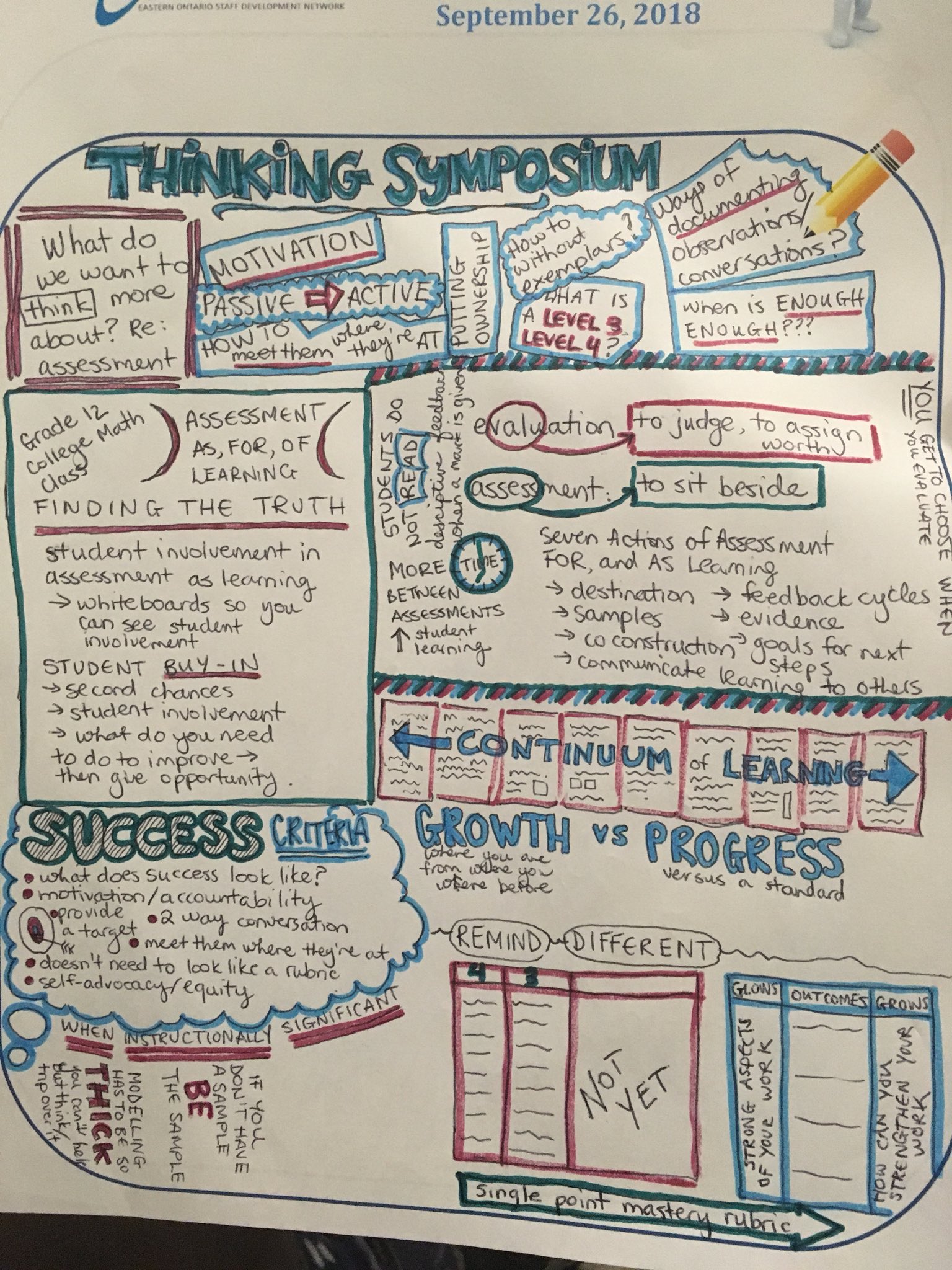
These are the notes that I took during the first day of the workshop. We focused mostly on developing success criteria with students. While this is something that I have done in the past, and feel relatively comfortable doing organically with students in math, I really don't have a handle on it in terms of how I teach science. Taking this opportunity to reflect on my practice means that I want to target a few things about how I am teaching my science course, and have students be more reflective about how they learn.
My grade nine science course is very project-based, and while there is choice and flexibility in how students present their work, many of the assignments are very structured. I don't necessarily think this is a bad thing -- especially at the beginning of the year. But, I think it would be good to give them increasingly more ownership of the material as the year progresses. It's a whole other job to work my way through this -- and something totally worth doing -- but, this week I'm focusing on assessment, so I'm going to let that lie for the moment, and focus on more assessment-based goals.
Goal #1: Have students understand what makes a good research process
Goal #2: Have students understand what makes a good research report.
*Bonus points if this can be used in some cross-curricular way in English. But, really I'm focusing on it through a science lens.*
So, how can I achieve my goals? What have I learned in my day of workshopping?
The very first thing that I want to do is take stock properly with each student about the research work that they have completed thus far, which really amounts to two projects for most students. I feel like for several reasons, I do less teaching in science than I do in math -- grade nine science especially. And I want to build in those learning moments so students are not just completing assignments to be finished them, instead they are building on what they have done so far and improving for the next time. The most valuable lessons that students can learn in a grade nine science course have very little to do with the material they are learning (the only subject area that directly carries forward is chemistry) and more with how to understand diagrams, how to read texts, how to perform experiments, and how to write up results of their research and experiments. This synthesis of and analysis of information is the skill that can carry forward into whatever else they study or do in life, so I think it's a valuable thing to target in the course.
How will I try to do this? I think for now, individually, I would talk with each student about the research projects they have completed. I might even print out a copy of what they have done along with the assignment sheet, and get them to self-assess where they are at. I like the idea of using the single point mastery rubric as a starting point -- I guess a conceptual starting point for me? And maybe just ask each student for one thing they did well (and why), and one thing they think that they could improve on (and why). This provides a jumping off point for us to start using the original report as a way to develop success criteria for their next research assignment. In a way, the kids are providing their own exemplar, or really their first assignment is kind of putting them somewhere on a learning continuum, and together we're mapping out what their next steps are.
Some things I am still struggling with:
How do I make sure their criteria are meaningful and thoughtful when it is only one person generating ideas? How wide or narrow do I want to focus on improving their reports -- should we target one area first, and then others? If so, who decides what is the most important (maybe their greatest area of need?) Would it be beneficial to do some of the constructing as a group (this depends on the people taking the course right now and whether they are able to generate discussions)? Maybe the students can create an initial set of criteria and improve on that as well as the semester goes on...
Students that are evaluated less often learn more. A mark detracts from any feedback that is given. Maybe a baby step to improve what I am doing in science is to conference with each student during which all of that constructing/self-reflecting I was talking about earlier happens. But then what do I do about the mark based on knowledge and understanding of material that is different from their ability to do research? Do I mark them on that then and there? Not show them the mark? Do they only get marks for work on later projects in the course, while the first ones are to build that capacity and skill? This is a lot easier to work through in a process-based course like English or even math, but what about courses where there is so much knowledge content that can't be cycled back to forever? Maybe marking in science needs to be more holistic and can then be looked at less frequently? I don't know yet.
Other things I learned today worth writing down:
I really found fascinating the root words of assessment and evaluation, and how they really relate to what is being done when you are "evaluating" versus assessing kids on where they are at. Again, I am super good at assessing in math, but the sheer mass of content in science means that I have often been evaluating most pieces of work that come in -- and where does the learning come in then?
That's it for now. Hopefully organizing my thoughts will lead to a useful second day tomorrow.
Comments
Post a Comment